
FAQs
Yes. If you have an existing pile of branches, storm debris or accumulated green waste on your property, we can come out with our chipper and process it in a single visit. We quote based on volume and site access.
Yes. On-site chipping is a standard part of our tree removal, pruning and land clearing services. All branches and green waste are chipped and either left as mulch or removed from your property. You do not need to arrange chipping separately when we are doing the tree work.
We supply a garden grade blend of mixed leaf and coarse hardwood woodchips. The material is sourced from our professional tree services and processed through commercial chippers. The varied chip size provides better moisture retention, weed suppression and soil enrichment than single-grade products. Size and colour may vary between deliveries due to the natural source material.
Most species respond well to crown lifting, but some are more sensitive than others. Very old or mature trees require extra caution, as large wounds on older trees heal more slowly and are more susceptible to decay. Our arborists assess each tree’s suitability before recommending work.
We grind to a minimum of 200–300mm below ground level as standard. If you need deeper grinding for construction, replanting or pool installation, we can accommodate that. We discuss your requirements during the assessment.
Yes. We work to your scope and reference your job or claim number on our quote so it is easy to track against the claim.
It depends on the species, size and conditions. Most relocated trees need 12 to 24 months of structured aftercare, including regular watering, monitoring and health checks, before they are fully established in their new position. Palms tend to establish faster than most hardwood species.
We provide arborist reports, tree risk assessments and inspection reports to support planning, asset management and development decisions. This includes Level 5 arborist reports for complex sites and high-value assets.
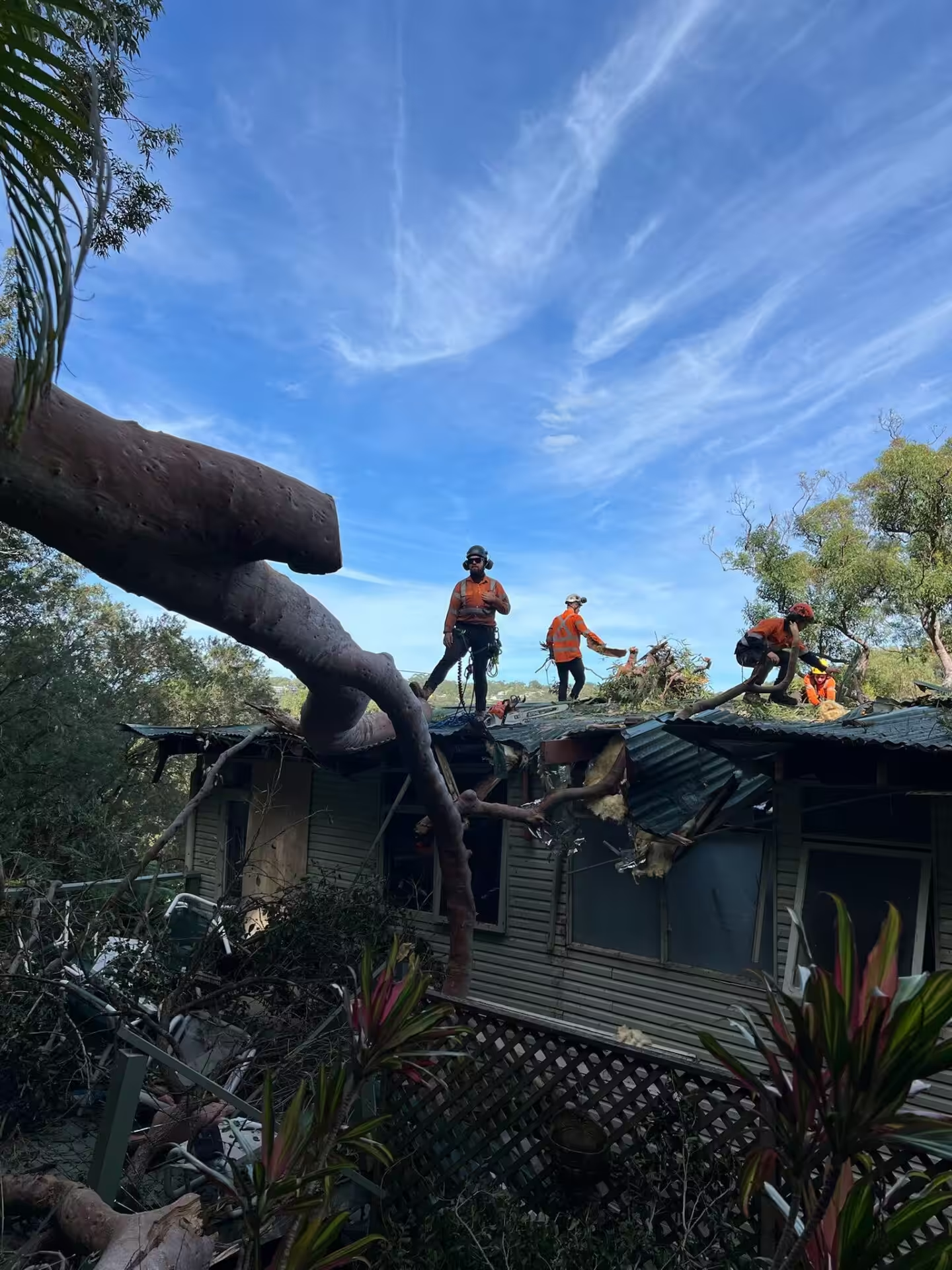
Yes. We prioritise dangerous, storm-damaged and fallen trees ahead of standard bookings, with after-hours call-out available. Call us and describe the situation, and we will get a qualified crew to you as soon as we can.
Yes. We work with developers, builders and project managers to coordinate tree relocation within broader construction timelines. We can stage relocations across development phases, hold trees in temporary nursery locations and coordinate with other trades on site. For more detail on our commercial and development transplanting services, visit Dixons Tree Transplanting.
It varies based on block size, vegetation density, terrain, access and whether stump grinding is included. A small residential block is a different scope to a multi-lot development. We provide a detailed quote after a site assessment so you understand the full cost before any work begins. Contact us for a free assessment.
Yes. We provide arborist reports and tree management plans for development applications, due diligence and risk management.
Generally, no. Stump grinding removes material below ground level and does not typically require council approval across our service area. If the original tree removal required a permit, the stump grinding is usually covered under that approval. We advise during the assessment if any permits are relevant.
We identify protected trees and approval requirements during the site assessment, advise on what is needed and provide documentation for council records and development consent conditions.
It depends on the number of trees, their size, species, access and the type of pruning required. A single tree might take an hour; a property full of mature trees might take a full day. We provide a detailed quote after an on-site assessment so you know the full scope and cost before any work begins. Contact us for a free assessment.
It depends on your council area. In the Blue Mountains, you generally need a permit to prune trees that are 4 metres or taller, have a crown spread of more than 4 metres, or are a mallee-formed Eucalyptus species. Rules differ across Penrith, Hawkesbury, Western Sydney and the Central Coast, so it is worth checking before any work begins. Some exemptions apply across most areas, including deadwood removal and selective pruning of branches directly overhanging your roof. We advise you during the assessment and help with the permit process if needed.
They overlap but are not identical. The 10/50 scheme provides a legal entitlement to clear without council approval in designated areas. An asset protection zone (APZ) is a requirement under the NSW Planning for Bush Fire Protection guidelines, typically applied to new developments through the DA process. If you need APZ clearing as part of a development, different rules and documentation may apply. We handle both and can advise on which applies to your situation.
It depends on the palm’s species, height, location, access and proximity to structures. A small palm in an open yard is a straightforward job. A 15-metre Phoenix palm next to a house with tight side access takes longer and costs more. We provide a detailed quote after an on-site assessment so you understand the full scope and cost before any work begins. Contact us for a free assessment.
Our commercial whole-tree chippers process large-diameter timber and high volumes. They handle everything from a single tree’s branches through to full land clearing waste. There is no job too large for our equipment.
It depends on the tree. As a general guide, the remaining live crown should not be reduced to less than two-thirds of the tree’s total height. Removing too many lower branches weakens the tree and can trigger excessive regrowth or structural instability. Our arborists assess each tree individually and recommend a safe lift height.
It depends on the number of trees, their species, size, access and the height of lift required. A single tree in an open yard is straightforward. Multiple large trees with limited access take longer. We provide a detailed quote after an on-site assessment so you understand the full scope and cost before any work begins. Contact us for a free assessment.
Yes. Trusted by Cumberland City Council, Blue Mountains City Council, Bayside Council, Transport for NSW, Soil Conservation Service and Sydney Trains.
Our entire approach is designed to prevent it. We dismantle palms from the top down, lowering each section on ropes where needed. Ground protection is set up for driveways, lawns and garden beds. We carry $50 million public liability insurance on every job.
We typically arrange an on-site assessment within 2–3 days of your enquiry. You’ll receive a detailed written quote in 24–48 hours of the site visit. For urgent or dangerous situations, we often respond faster.
It depends on the volume. A single tree’s worth of branches takes minutes. A full land clearing project may take several hours. We give you an expected timeframe in the quote so you know what to plan for.
All branches and debris are chipped on site and removed. Timber can be cut into manageable rounds and left for you, or removed entirely. Grinder shavings are retained on site and naturally backfill the hole left by the stump. We discuss your preferences before we start.
Yes. We remove Cocos palms, Phoenix palms (Canary Island Date Palms), Bangalow palms, Cotton palms, Washingtonia palms, Golden Cane palms, Alexandra palms and any other species you have on your property. If you are not sure what species your palm is, we will identify it during the assessment.
In some cases, yes. If the palm is healthy and you want to keep it, we can remove dead fronds, fruit clusters and debris as a maintenance service. However, if the palm has outgrown its position, is structurally compromised or is a Cocos palm attracting pests, removal is usually the better long-term solution. We will give you an honest recommendation during the assessment.
Tree removal (including large, dangerous and emergency removals), tree pruning, stump grinding, tree relocation, land clearing, chipping and mulching and bulk mulch delivery. If it involves trees in the Blue Mountains, Penrith, Greater Sydney or Central Coast, we handle it.
Most tree species in the Blue Mountains can be pruned year-round, though winter and early spring are ideal for many species because trees are dormant and branch structure is easier to assess. We will recommend the best timing based on your specific trees during the assessment.
Palm stumps are denser and more fibrous than hardwood stumps, but our commercial grinders handle them without issue. We grind palm stumps to a minimum of 200–300mm below ground level, the same standard as any other stump. Deeper grinding is available if you are planning to turf, landscape or build over the area.
It varies based on the tree’s size, species, location, access and complexity. We provide a detailed quote after an on-site assessment, so you’ll understand the full scope and cost before any work begins.
All branches and vegetation are chipped on site using our commercial equipment. Timber from larger trees is cut into manageable rounds and left for you, or removed entirely. Stump grinding is included or quoted as an option. We discuss your preference before starting and leave your property clean.
Yes. We hold $50 million public liability insurance, employ qualified arborists and maintain ISO 9001, ISO 14001 and ISO 45001 accreditation. We provide all documentation you need for your records, insurance claims or council applications.
It may. The 10/50 scheme allows property owners in designated bushfire areas to clear trees within 10 metres of a dwelling and underlying vegetation (not trees) within 50 metres, without council approval. Most of the Blue Mountains is within a designated Vegetation Clearing Entitlement Area. We can check whether your property qualifies and carry out the clearing to the scheme’s Code of Practice requirements.
In the Blue Mountains, you generally need a permit to prune trees that are 4 metres or taller, have a crown spread of more than 4 metres, or are a mallee-formed eucalyptus species. Some exemptions apply, including selective pruning of branches directly overhanging your roof. We advise you during the assessment and help with the permit process if needed.
Emergency removal of an imminently dangerous tree is generally treated differently to planned removal. Many councils allow it without prior approval, but proper documentation matters. We assess this on site and advise you.
You can remove most trees within 10 metres of an external wall of your dwelling, but there are exclusions. Trees in areas containing threatened species habitat, Aboriginal heritage sites or land subject to a property vegetation plan may not be cleared. Mangroves and vegetation within coastal wetlands are also excluded. We identify any exclusions during the site assessment.
The Blue Mountains, Penrith, Hawkesbury, Greater Western Sydney and the Central Coast. For larger projects our equipment travels further, so contact us if you are outside these areas.
Yes. We work with builders, developers and project managers regularly. We schedule clearing to align with your construction timeline, coordinate access with other trades on site and provide documentation for council and project records.
No. Crown lifting is a targeted pruning technique that removes specific lower branches using proper cuts that promote healing. “Tree lopping” refers to indiscriminate cutting that often causes long-term damage. We provide professional pruning to Australian Standards, not lopping.
We prioritise make-safe works ahead of standard bookings, with after-hours call-out. We have the capacity to be on site within 1 hour Sydney wide and up to 24 hours for all of NSW
It depends on the number and size of trees within the 10-metre zone, the density of vegetation in the 50-metre zone, site access and terrain. A few small trees on a flat block is a different scope to large eucalypts on a steep hillside. We provide a detailed quote after an on-site assessment so you understand the full cost before any work begins. Contact us for a free assessment.
It depends on the tree’s size, species and your local council’s rules. Requirements vary across the Blue Mountains, Penrith, Hawkesbury, Western Sydney and the Central Coast, so it is worth checking before any work begins. We advise you during the assessment and help with the permit process if needed. Some properties in bushfire-prone areas may also qualify for clearing under the 10/50 Vegetation Clearing Scheme without council approval.
We remove everything: fronds, trunk sections, fruit and fibre. Palm trunks are not suitable for firewood or timber due to their fibrous structure, so all material is processed and removed from your property. Using palm tree mulch can be problematic because the highly fibrous husks act like a soggy sponge, attracting pests and retaining excessive moisture.
The 10/50 Vegetation Clearing Scheme is a NSW government program that allows property owners in designated bushfire-prone areas to clear trees within 10 metres of their home and remove underlying vegetation within 50 metres, without council approval. It is designed to reduce bushfire risk by creating defendable space around dwellings. Most of the Blue Mountains falls within an eligible area.
Not all trees are suitable for relocation. Success depends on species, health, age, root structure and the conditions at the destination site. Some species tolerate transplanting well, particularly palms, while others are more sensitive. Our arborists assess each tree individually and give you an honest answer on viability before any work begins. We do not relocate trees in pots or containers.
In most cases, yes. If the tree meets size thresholds for council regulation, relocation typically requires the same approvals as removal. However, councils often view relocation more favourably than removal in DA assessments. We provide all necessary arborist reports and documentation to support your application.
Yes. We prioritise make-safe works so the immediate hazard is removed and the site is safe for assessment and repair. The full removal and clean-up follow once the scope is agreed.
It varies by species, age and location. As a general guide, most established trees benefit from a professional assessment every 2–3 years. Fast-growing species or trees near structures may need more frequent attention. We can set up a maintenance schedule tailored to your property.
Our commercial chippers handle branches and timber well beyond what residential or hire-grade equipment can manage. If you are unsure whether your material is suitable, send us photos and we will advise.
As a guide, 1 cubic metre of mulch covers approximately 10 square metres at 100mm depth. A typical suburban garden with established beds usually needs 5–10m³ for comprehensive coverage.
It varies significantly based on the tree’s species, size, rootball dimensions, transport distance, access at both sites and the level of aftercare required. A small tree moved within a property costs considerably less than a large specimen relocated across Sydney with crane assistance. We provide a detailed proposal after a site assessment so you understand the full scope and cost before committing. Contact us for a free assessment.
We deliver throughout the Blue Mountains (Penrith to Mt Victoria), Western Sydney and across the greater Sydney area for commercial orders of 30m³ or more. Free delivery between Penrith and Katoomba. Delivery outside this area is quoted based on location. Contact us before ordering if you are unsure about delivery to your area.
Yes. The mulch we sell is the same material produced by our tree removal, pruning and chipping work. It is processed through commercial chippers and supplied as a quality garden grade product. Ordering from us means you are getting genuine hardwood mulch from a source you can trust.
All branches and debris are chipped on site and removed from your property. If you would like to keep wood chips as garden mulch, we are happy to arrange that. We discuss your preference before we start.
Your property must be within a mapped Vegetation Clearing Entitlement Area. The NSW Rural Fire Service provides an online tool where you can check your address. We also check eligibility as the first step in every 10/50 assessment, so you will know before we quote any work.
When done properly by a qualified arborist, crown lifting does not damage the tree. The key is removing the right branches, at the right height, with correct cuts that allow the tree to heal naturally. Poor crown lifting, where too many branches are removed or cuts are made in the wrong position, can cause decay, regrowth problems and structural weakness. That is why it matters who does the work.
Yes. A significant share of our work is commercial. We coordinate tree removal, clearing and pruning with construction programs and other trades so tree work does not delay the build.
Allow up to 7 business days for residential deliveries and up to 5 business days for commercial orders. We can often deliver sooner depending on availability. If you have a specific date in mind, let us know when ordering and we will do our best to accommodate it.
Tree pruning is the selective removal of specific branches using proper technique to maintain tree health, structure and safety. It follows Australian Standard AS 4373-2007. “Tree lopping” typically refers to indiscriminate cutting that removes large sections of the canopy, often causing long-term damage to the tree. We provide professional pruning, not lopping.
No. The 10/50 scheme only allows removal of underlying vegetation (shrubs, scrub, groundcover) in the zone between 10 and 50 metres from your dwelling. Trees in this zone cannot be removed under the scheme. If trees in the 50-metre zone need removing, a separate council application is required. We can advise on that process.
Yes. We work alongside insurance builders, assessors and loss adjusters on storm and tree damage claims. We work to your scope, reference your job on our quote and coordinate with you through the repair.
Crown lifting is a pruning technique that involves removing the lower branches of a tree to raise the height of the canopy. It creates clearance underneath the tree for access, light and maintenance. It is a recognised specification under Australian Standard AS 4373-2007 and, when done properly, does not harm the tree.
It depends on the species and growth rate. Most crown lifting work lasts several years before regrowth or new low branches need attention. Fast-growing species may need maintenance every 2–3 years. We can set up a maintenance schedule tailored to your property.
Yes. Our equipment fits through standard residential gates and operates in side passages, garden beds and other confined areas. If access is particularly tight, we assess the situation on site and advise on the best approach.
We prioritise emergencies and offer after-hours call-out. Actual response time depends on the situation, your location and current demand, which is higher during storm season. For a tree on a building or blocking access, call rather than email.
Our garden grade mulch is $50 per cubic metre including GST. Residential packages are available at 5m³ ($250), 10m³ ($500) and 15m³ ($750). Commercial orders start at 30m³ and are available for delivery across Sydney. Free delivery between Penrith and Katoomba. Delivery outside this area is quoted based on location. If you need regular supply for ongoing projects, we can arrange recurring deliveries to suit your schedule.
All branches and debris are chipped on site and removed from your property. If you would like to keep wood chips as garden mulch, we are happy to arrange that. We discuss your preference before we start.
It depends on the tree’s size, species, location, access and proximity to structures. We provide a detailed quote after an on-site assessment so you understand the full scope and cost before any work begins.
Crown lifting removes lower branches to raise the canopy height. Crown thinning removes selected branches throughout the canopy to reduce density and allow more light through. They address different problems and are often done together. Our arborists recommend the right combination based on your trees and what you are trying to achieve.
In many parts of the Blue Mountains, Penrith, Hawkesbury, Western Sydney and the Central Coast, yes. Trees above a certain size or within heritage overlays typically require council consent. We advise you on whether your tree is likely to need approval and provide arborist reports to support your application. Some exemptions apply, including trees within 10 metres of a dwelling under the 10/50 Vegetation Clearing Scheme.
In many cases, yes. We tip the mulch in a designated location of your choice on your property. However, depending on the material and site conditions, not all mulch may be suitable to retain. We discuss your preference before we start and let you know what is practical for your job.
Yes. We carry $50 million public liability insurance and workers’ compensation on every job. Our team includes qualified arborists and we hold ISO 9001, ISO 14001 and ISO 45001 accreditation. We provide all documentation you need for insurance, council applications or development approvals.
The terms are used interchangeably. Both refer to the process of excavating a tree from one location and replanting it in another while keeping the root system, trunk and canopy intact. The goal is the same: preserving the tree rather than removing it.
NSW and East Coast Australia. For larger storm events our crews travel further, so contact us if the job is outside these areas.
We can provide an arborist’s assessment to support a claim. The level of reporting depends on the claim, and we will confirm what is needed when you send the job through.
We chip the branches and remove all debris from your property. If you would like to keep timber for firewood, we are happy to arrange that. We discuss your preference before we start.
The Blue Mountains, Greater Western Sydney including Penrith and the Hawkesbury region. We also have a dedicated Central Coast team. Not sure if you’re in our area? Give us a call.
All trees and vegetation are processed on site using our commercial chippers. Green waste becomes quality mulch that can stay on your property or be removed. Timber is cut into manageable rounds and left for you, or removed entirely. Stumps are ground below ground level. We discuss your preferences before starting.
We remove all branches and debris from your property. If you’d like to keep timber for firewood or wood chips for garden mulch, we’re happy to arrange that. We discuss your preference before we start.
We deliver by large tipper truck and will place the mulch as close to your preferred location as site access allows. The truck needs sufficient space to enter and tip safely. If you have limited access, call us before ordering and we will advise on the best approach.
A single residential block typically takes one to two days depending on vegetation density and access. Larger commercial or multi-lot sites may take several days to a week or more. We confirm the expected timeframe in your quote and coordinate with your project schedule.
Make-safe works remove the immediate danger so your property is safe to be around. That might mean taking the weight off a damaged structure or removing a hanging limb. The full removal and clean-up can then follow.
Yes. Our arborists hold AQF Level 3 qualifications in arboriculture, we carry $50 million public liability insurance and we hold ISO 9001, ISO 14001 and ISO 45001 accreditation. We’ve been operating since 2009.
It depends on the stump’s diameter, location, access and root spread. Single stumps on accessible properties are straightforward to quote. We offer package pricing for multiple stumps on the same property. Contact us for a free assessment and detailed quote.
The scheme does not require you to notify council or the RFS before clearing, provided you follow the Code of Practice. However, we recommend having a professional assessment to confirm what qualifies under the scheme. Clearing trees or vegetation that falls outside the entitlement can result in fines. We ensure all clearing stays within the scheme’s rules.
Not necessarily. After we have discussed the work plan with you, our crew can carry out the removal without supervision. We will follow up the next day to make sure you are happy with the result.
Yes. We hold $50 million public liability insurance and workers’ compensation, and ISO 9001, 14001 and 45001 accreditation. We provide certificates of currency on request for your panel and claim files.
Yes. We hold $50 million public liability insurance, workers’ compensation, and ISO 9001, 14001 and 45001 accreditation. We provide all documentation for procurement and audit.
The Blue Mountains, Penrith, Hawkesbury, Greater Sydney and the Central Coast. Contact us to discuss projects outside these areas.
Proper pruning does not damage trees. It promotes healthy growth, removes compromised branches and improves structure. Poor pruning (lopping, topping, over-thinning) does cause damage. That is why it matters who does the work and how they do it. Our arborists prune to Australian Standards and assess each tree individually.
In most cases, yes. On-site chipping is faster, avoids multiple trailer or truck runs, reduces your disposal costs and produces usable mulch. It also reduces the environmental impact of transporting waste to landfill.
Yes. Our qualified arborists identify heritage and protected vegetation during assessment and advise on management within environmental and heritage requirements.
We relocate trees across Sydney, the Blue Mountains, Western Sydney, the Hawkesbury, the Central Coast and the South Coast. Our service area for tree relocation is broader than our general tree services because we operate specialised equipment that travels to wherever the project requires.
Yes. We have immediate capabilities to address fallen and dangerous trees on roads, in parks, and across public assets.
If a power line is down or a tree is in contact with one, stay clear and contact your network provider first. Once the area is safe, we can remove the tree. We will advise on this when you call.
Yes. We supply bulk mulch for landscapers, developers, councils and commercial property managers across Sydney. Commercial orders start at 30m³ with Sydney-wide delivery. For regular supply or ongoing project needs, contact us to discuss recurring delivery arrangements.
It often does, but it depends on your policy and the cause of the damage. We are not your insurer and cannot confirm cover. What we can do is provide the arborist assessment, photographs and itemised quote your insurer or insurance builder needs to assess the claim. See our insurance tree services for how we work with builders managing claims.
Our entire approach is designed to prevent it. Sectional dismantling and rigging let us lower timber in controlled pieces and we set up ground protection where needed. We carry $50 million public liability insurance.
We deliver throughout the Blue Mountains from Penrith to Katoomba. Free delivery between Penrith and Katoomba. Delivery outside this area is quoted based on location. Contact us before ordering if you are outside the Penrith to Katoomba corridor.
In most cases, yes. Trees and vegetation in the Blue Mountains are protected under local planning controls. Trees 4 metres or taller, trees with a crown spread over 4 metres and all mallee-formed eucalyptus species require a permit from Blue Mountains City Council before removal. Vegetation shown for removal on an approved development consent does not need a separate permit. We advise you on the requirements during the site assessment and help with the approval process.
Our equipment is designed to minimise disruption. We protect surrounding surfaces and work carefully around garden beds, driveways and fences. Some surface disturbance immediately around the stump is unavoidable, but it settles quickly and the area can be turfed or planted over.
Most residential removals are completed in a single day. Very large trees, multi-tree jobs, or complex sites may take two or more days. We confirm the expected timeframe in your quote.
It depends on the species and your local council rules. Cocos palms are classified as an environmental weed in NSW and most councils allow their removal without a permit. Other species, including Phoenix palms and native Bangalow palms, may require approval if they meet size thresholds. In the Blue Mountains, trees 4 metres or taller or with a crown spread over 4 metres generally need a permit. We advise you during the assessment and help with the permit process if needed.
Yes, and it is often more economical. When we remove a tree, we can often grind the stump in the same visit, saving you a second appointment and reducing the overall cost. We include stump grinding as an option in all tree removal quotes.
NSW and East Coast Australia. For larger storm events our crews travel further, so contact us if the job is outside these areas.
Yes. We hold $50 million public liability insurance, workers’ compensation, and ISO 9001, 14001 and 45001 accreditation. We provide all documentation for procurement and audit.
Yes. A significant share of our work is commercial. We coordinate tree removal, clearing and pruning with construction programs and other trades so tree work does not delay the build.
Yes. Our qualified arborists identify heritage and protected vegetation during assessment and advise on management within environmental and heritage requirements.
It varies based on the tree’s size, species, location, access and complexity. We provide a detailed quote after an on-site assessment, so you’ll understand the full scope and cost before any work begins.
Yes. Trusted by Cumberland City Council, Blue Mountains City Council, Bayside Council, Transport for NSW, Soil Conservation Service and Sydney Trains.
We can provide an arborist’s assessment to support a claim. The level of reporting depends on the claim, and we will confirm what is needed when you send the job through.
Yes. We hold $50 million public liability insurance, employ qualified arborists and maintain ISO 9001, ISO 14001 and ISO 45001 accreditation. We provide all documentation you need for your records, insurance claims or council applications.
The Blue Mountains, Penrith, Hawkesbury, Greater Sydney and the Central Coast. Contact us to discuss projects outside these areas.
The Blue Mountains, Penrith, Hawkesbury, Greater Western Sydney and the Central Coast. For larger projects our equipment travels further, so contact us if you are outside these areas.
Yes. We work to your scope and reference your job or claim number on our quote so it is easy to track against the claim.
The Blue Mountains, Greater Western Sydney including Penrith and the Hawkesbury region. We also have a dedicated Central Coast team. Not sure if you’re in our area? Give us a call.
Yes. We hold $50 million public liability insurance and workers’ compensation, and ISO 9001, 14001 and 45001 accreditation. We provide certificates of currency on request for your panel and claim files.
It depends on the tree’s size, species and your local council’s rules. Requirements vary across the Blue Mountains, Penrith, Hawkesbury, Western Sydney and the Central Coast, so it is worth checking before any work begins. We advise you during the assessment and help with the permit process if needed. Some properties in bushfire-prone areas may also qualify for clearing under the 10/50 Vegetation Clearing Scheme without council approval.
Tree removal (including large, dangerous and emergency removals), tree pruning, stump grinding, tree relocation, land clearing, chipping and mulching and bulk mulch delivery. If it involves trees in the Blue Mountains, Penrith, Greater Sydney or Central Coast, we handle it.
We identify protected trees and approval requirements during the site assessment, advise on what is needed and provide documentation for council records and development consent conditions.
We typically arrange an on-site assessment within 2–3 days of your enquiry. You’ll receive a detailed written quote in 24–48 hours of the site visit. For urgent or dangerous situations, we often respond faster.
We remove all branches and debris from your property. If you’d like to keep timber for firewood or wood chips for garden mulch, we’re happy to arrange that. We discuss your preference before we start.
Yes. We work alongside insurance builders, assessors and loss adjusters on storm and tree damage claims. We work to your scope, reference your job on our quote and coordinate with you through the repair.
We provide arborist reports, tree risk assessments and inspection reports to support planning, asset management and development decisions. This includes Level 5 arborist reports for complex sites and high-value assets.
Yes. We prioritise make-safe works so the immediate hazard is removed and the site is safe for assessment and repair. The full removal and clean-up follow once the scope is agreed.
We prioritise make-safe works ahead of standard bookings, with after-hours call-out. We have the capacity to be on site within 1 hour Sydney wide and up to 24 hours for all of NSW
We chip the branches and remove all debris from your property. If you would like to keep timber for firewood, we are happy to arrange that. We discuss your preference before we start.
All branches and debris are chipped on site and removed. Timber can be cut into manageable rounds and left for you, or removed entirely. Grinder shavings are retained on site and naturally backfill the hole left by the stump. We discuss your preferences before we start.
Yes. We have immediate capabilities to address fallen and dangerous trees on roads, in parks, and across public assets.
If a power line is down or a tree is in contact with one, stay clear and contact your network provider first. Once the area is safe, we can remove the tree. We will advise on this when you call.
Yes. Our arborists hold AQF Level 3 qualifications in arboriculture, we carry $50 million public liability insurance and we hold ISO 9001, ISO 14001 and ISO 45001 accreditation. We’ve been operating since 2009.
Emergency removal of an imminently dangerous tree is generally treated differently to planned removal. Many councils allow it without prior approval, but proper documentation matters. We assess this on site and advise you.
Our entire approach is designed to prevent it. Sectional dismantling and rigging let us lower timber in controlled pieces and we set up ground protection where needed. We carry $50 million public liability insurance.
We prioritise emergencies and offer after-hours call-out. Actual response time depends on the situation, your location and current demand, which is higher during storm season. For a tree on a building or blocking access, call rather than email.
Not necessarily. After we have discussed the work plan with you, our crew can carry out the removal without supervision. We will follow up the next day to make sure you are happy with the result.
Most residential removals are completed in a single day. Very large trees, multi-tree jobs, or complex sites may take two or more days. We confirm the expected timeframe in your quote.
It depends on the tree’s size, species, location, access and proximity to structures. We provide a detailed quote after an on-site assessment so you understand the full scope and cost before any work begins.
In many parts of the Blue Mountains, Penrith, Hawkesbury, Western Sydney and the Central Coast, yes. Trees above a certain size or within heritage overlays typically require council consent. We advise you on whether your tree is likely to need approval and provide arborist reports to support your application. Some exemptions apply, including trees within 10 metres of a dwelling under the 10/50 Vegetation Clearing Scheme.
Yes. We prioritise dangerous, storm-damaged and fallen trees ahead of standard bookings, with after-hours call-out available. Call us and describe the situation, and we will get a qualified crew to you as soon as we can.
Yes. We provide arborist reports and tree management plans for development applications, due diligence and risk management.
Make-safe works remove the immediate danger so your property is safe to be around. That might mean taking the weight off a damaged structure or removing a hanging limb. The full removal and clean-up can then follow.
It often does, but it depends on your policy and the cause of the damage. We are not your insurer and cannot confirm cover. What we can do is provide the arborist assessment, photographs and itemised quote your insurer or insurance builder needs to assess the claim. See our insurance tree services for how we work with builders managing claims.
Palm stumps are denser and more fibrous than hardwood stumps, but our commercial grinders handle them without issue. We grind palm stumps to a minimum of 200–300mm below ground level, the same standard as any other stump. Deeper grinding is available if you are planning to turf, landscape or build over the area.
Our entire approach is designed to prevent it. We dismantle palms from the top down, lowering each section on ropes where needed. Ground protection is set up for driveways, lawns and garden beds. We carry $50 million public liability insurance on every job.
In some cases, yes. If the palm is healthy and you want to keep it, we can remove dead fronds, fruit clusters and debris as a maintenance service. However, if the palm has outgrown its position, is structurally compromised or is a Cocos palm attracting pests, removal is usually the better long-term solution. We will give you an honest recommendation during the assessment.
We remove everything: fronds, trunk sections, fruit and fibre. Palm trunks are not suitable for firewood or timber due to their fibrous structure, so all material is processed and removed from your property. Using palm tree mulch can be problematic because the highly fibrous husks act like a soggy sponge, attracting pests and retaining excessive moisture.
It depends on the species and your local council rules. Cocos palms are classified as an environmental weed in NSW and most councils allow their removal without a permit. Other species, including Phoenix palms and native Bangalow palms, may require approval if they meet size thresholds. In the Blue Mountains, trees 4 metres or taller or with a crown spread over 4 metres generally need a permit. We advise you during the assessment and help with the permit process if needed.
It depends on the palm’s species, height, location, access and proximity to structures. A small palm in an open yard is a straightforward job. A 15-metre Phoenix palm next to a house with tight side access takes longer and costs more. We provide a detailed quote after an on-site assessment so you understand the full scope and cost before any work begins. Contact us for a free assessment.
Yes. We remove Cocos palms, Phoenix palms (Canary Island Date Palms), Bangalow palms, Cotton palms, Washingtonia palms, Golden Cane palms, Alexandra palms and any other species you have on your property. If you are not sure what species your palm is, we will identify it during the assessment.
No. The 10/50 scheme only allows removal of underlying vegetation (shrubs, scrub, groundcover) in the zone between 10 and 50 metres from your dwelling. Trees in this zone cannot be removed under the scheme. If trees in the 50-metre zone need removing, a separate council application is required. We can advise on that process.
The scheme does not require you to notify council or the RFS before clearing, provided you follow the Code of Practice. However, we recommend having a professional assessment to confirm what qualifies under the scheme. Clearing trees or vegetation that falls outside the entitlement can result in fines. We ensure all clearing stays within the scheme’s rules.
It depends on the number and size of trees within the 10-metre zone, the density of vegetation in the 50-metre zone, site access and terrain. A few small trees on a flat block is a different scope to large eucalypts on a steep hillside. We provide a detailed quote after an on-site assessment so you understand the full cost before any work begins. Contact us for a free assessment.
You can remove most trees within 10 metres of an external wall of your dwelling, but there are exclusions. Trees in areas containing threatened species habitat, Aboriginal heritage sites or land subject to a property vegetation plan may not be cleared. Mangroves and vegetation within coastal wetlands are also excluded. We identify any exclusions during the site assessment.
Your property must be within a mapped Vegetation Clearing Entitlement Area. The NSW Rural Fire Service provides an online tool where you can check your address. We also check eligibility as the first step in every 10/50 assessment, so you will know before we quote any work.
The 10/50 Vegetation Clearing Scheme is a NSW government program that allows property owners in designated bushfire-prone areas to clear trees within 10 metres of their home and remove underlying vegetation within 50 metres, without council approval. It is designed to reduce bushfire risk by creating defendable space around dwellings. Most of the Blue Mountains falls within an eligible area.
All branches and vegetation are chipped on site using our commercial equipment. Timber from larger trees is cut into manageable rounds and left for you, or removed entirely. Stump grinding is included or quoted as an option. We discuss your preference before starting and leave your property clean.
They overlap but are not identical. The 10/50 scheme provides a legal entitlement to clear without council approval in designated areas. An asset protection zone (APZ) is a requirement under the NSW Planning for Bush Fire Protection guidelines, typically applied to new developments through the DA process. If you need APZ clearing as part of a development, different rules and documentation may apply. We handle both and can advise on which applies to your situation.
Proper pruning does not damage trees. It promotes healthy growth, removes compromised branches and improves structure. Poor pruning (lopping, topping, over-thinning) does cause damage. That is why it matters who does the work and how they do it. Our arborists prune to Australian Standards and assess each tree individually.
It varies by species, age and location. As a general guide, most established trees benefit from a professional assessment every 2–3 years. Fast-growing species or trees near structures may need more frequent attention. We can set up a maintenance schedule tailored to your property.
It depends on your council area. In the Blue Mountains, you generally need a permit to prune trees that are 4 metres or taller, have a crown spread of more than 4 metres, or are a mallee-formed Eucalyptus species. Rules differ across Penrith, Hawkesbury, Western Sydney and the Central Coast, so it is worth checking before any work begins. Some exemptions apply across most areas, including deadwood removal and selective pruning of branches directly overhanging your roof. We advise you during the assessment and help with the permit process if needed.
Most tree species in the Blue Mountains can be pruned year-round, though winter and early spring are ideal for many species because trees are dormant and branch structure is easier to assess. We will recommend the best timing based on your specific trees during the assessment.
Tree pruning is the selective removal of specific branches using proper technique to maintain tree health, structure and safety. It follows Australian Standard AS 4373-2007. “Tree lopping” typically refers to indiscriminate cutting that removes large sections of the canopy, often causing long-term damage to the tree. We provide professional pruning, not lopping.
It depends on the number of trees, their size, species, access and the type of pruning required. A single tree might take an hour; a property full of mature trees might take a full day. We provide a detailed quote after an on-site assessment so you know the full scope and cost before any work begins. Contact us for a free assessment.
All branches and debris are chipped on site and removed from your property. If you would like to keep wood chips as garden mulch, we are happy to arrange that. We discuss your preference before we start.
Generally, no. Stump grinding removes material below ground level and does not typically require council approval across our service area. If the original tree removal required a permit, the stump grinding is usually covered under that approval. We advise during the assessment if any permits are relevant.
Yes, and it is often more economical. When we remove a tree, we can often grind the stump in the same visit, saving you a second appointment and reducing the overall cost. We include stump grinding as an option in all tree removal quotes.
Our equipment is designed to minimise disruption. We protect surrounding surfaces and work carefully around garden beds, driveways and fences. Some surface disturbance immediately around the stump is unavoidable, but it settles quickly and the area can be turfed or planted over.
Yes. Our equipment fits through standard residential gates and operates in side passages, garden beds and other confined areas. If access is particularly tight, we assess the situation on site and advise on the best approach.
We grind to a minimum of 200–300mm below ground level as standard. If you need deeper grinding for construction, replanting or pool installation, we can accommodate that. We discuss your requirements during the assessment.
It depends on the stump’s diameter, location, access and root spread. Single stumps on accessible properties are straightforward to quote. We offer package pricing for multiple stumps on the same property. Contact us for a free assessment and detailed quote.
In most cases, yes. If the tree meets size thresholds for council regulation, relocation typically requires the same approvals as removal. However, councils often view relocation more favourably than removal in DA assessments. We provide all necessary arborist reports and documentation to support your application.
We relocate trees across Sydney, the Blue Mountains, Western Sydney, the Hawkesbury, the Central Coast and the South Coast. Our service area for tree relocation is broader than our general tree services because we operate specialised equipment that travels to wherever the project requires.
The terms are used interchangeably. Both refer to the process of excavating a tree from one location and replanting it in another while keeping the root system, trunk and canopy intact. The goal is the same: preserving the tree rather than removing it.
It depends on the species, size and conditions. Most relocated trees need 12 to 24 months of structured aftercare, including regular watering, monitoring and health checks, before they are fully established in their new position. Palms tend to establish faster than most hardwood species.
Not all trees are suitable for relocation. Success depends on species, health, age, root structure and the conditions at the destination site. Some species tolerate transplanting well, particularly palms, while others are more sensitive. Our arborists assess each tree individually and give you an honest answer on viability before any work begins. We do not relocate trees in pots or containers.
It varies significantly based on the tree’s species, size, rootball dimensions, transport distance, access at both sites and the level of aftercare required. A small tree moved within a property costs considerably less than a large specimen relocated across Sydney with crane assistance. We provide a detailed proposal after a site assessment so you understand the full scope and cost before committing. Contact us for a free assessment.
Yes. We work with developers, builders and project managers to coordinate tree relocation within broader construction timelines. We can stage relocations across development phases, hold trees in temporary nursery locations and coordinate with other trades on site. For more detail on our commercial and development transplanting services, visit Dixons Tree Transplanting.
Our commercial chippers handle branches and timber well beyond what residential or hire-grade equipment can manage. If you are unsure whether your material is suitable, send us photos and we will advise.
It depends on the volume. A single tree’s worth of branches takes minutes. A full land clearing project may take several hours. We give you an expected timeframe in the quote so you know what to plan for.
Our commercial whole-tree chippers process large-diameter timber and high volumes. They handle everything from a single tree’s branches through to full land clearing waste. There is no job too large for our equipment.
Yes. If you have an existing pile of branches, storm debris or accumulated green waste on your property, we can come out with our chipper and process it in a single visit. We quote based on volume and site access.
In many cases, yes. We tip the mulch in a designated location of your choice on your property. However, depending on the material and site conditions, not all mulch may be suitable to retain. We discuss your preference before we start and let you know what is practical for your job.
Yes. On-site chipping is a standard part of our tree removal, pruning and land clearing services. All branches and green waste are chipped and either left as mulch or removed from your property. You do not need to arrange chipping separately when we are doing the tree work.
In most cases, yes. On-site chipping is faster, avoids multiple trailer or truck runs, reduces your disposal costs and produces usable mulch. It also reduces the environmental impact of transporting waste to landfill.
We deliver by large tipper truck and will place the mulch as close to your preferred location as site access allows. The truck needs sufficient space to enter and tip safely. If you have limited access, call us before ordering and we will advise on the best approach.
Allow up to 7 business days for residential deliveries and up to 5 business days for commercial orders. We can often deliver sooner depending on availability. If you have a specific date in mind, let us know when ordering and we will do our best to accommodate it.
We deliver throughout the Blue Mountains (Penrith to Mt Victoria), Western Sydney and across the greater Sydney area for commercial orders of 30m³ or more. Free delivery between Penrith and Katoomba. Delivery outside this area is quoted based on location. Contact us before ordering if you are unsure about delivery to your area.
We supply a garden grade blend of mixed leaf and coarse hardwood woodchips. The material is sourced from our professional tree services and processed through commercial chippers. The varied chip size provides better moisture retention, weed suppression and soil enrichment than single-grade products. Size and colour may vary between deliveries due to the natural source material.
As a guide, 1 cubic metre of mulch covers approximately 10 square metres at 100mm depth. A typical suburban garden with established beds usually needs 5–10m³ for comprehensive coverage.
Our garden grade mulch is $50 per cubic metre including GST. Residential packages are available at 5m³ ($250), 10m³ ($500) and 15m³ ($750). Commercial orders start at 30m³ and are available for delivery across Sydney. Free delivery between Penrith and Katoomba. Delivery outside this area is quoted based on location. If you need regular supply for ongoing projects, we can arrange recurring deliveries to suit your schedule.
Yes. The mulch we sell is the same material produced by our tree removal, pruning and chipping work. It is processed through commercial chippers and supplied as a quality garden grade product. Ordering from us means you are getting genuine hardwood mulch from a source you can trust.
Yes. We supply bulk mulch for landscapers, developers, councils and commercial property managers across Sydney. Commercial orders start at 30m³ with Sydney-wide delivery. For regular supply or ongoing project needs, contact us to discuss recurring delivery arrangements.
All trees and vegetation are processed on site using our commercial chippers. Green waste becomes quality mulch that can stay on your property or be removed. Timber is cut into manageable rounds and left for you, or removed entirely. Stumps are ground below ground level. We discuss your preferences before starting.
Yes. We work with builders, developers and project managers regularly. We schedule clearing to align with your construction timeline, coordinate access with other trades on site and provide documentation for council and project records.
It may. The 10/50 scheme allows property owners in designated bushfire areas to clear trees within 10 metres of a dwelling and underlying vegetation (not trees) within 50 metres, without council approval. Most of the Blue Mountains is within a designated Vegetation Clearing Entitlement Area. We can check whether your property qualifies and carry out the clearing to the scheme’s Code of Practice requirements.
A single residential block typically takes one to two days depending on vegetation density and access. Larger commercial or multi-lot sites may take several days to a week or more. We confirm the expected timeframe in your quote and coordinate with your project schedule.
In most cases, yes. Trees and vegetation in the Blue Mountains are protected under local planning controls. Trees 4 metres or taller, trees with a crown spread over 4 metres and all mallee-formed eucalyptus species require a permit from Blue Mountains City Council before removal. Vegetation shown for removal on an approved development consent does not need a separate permit. We advise you on the requirements during the site assessment and help with the approval process.
It varies based on block size, vegetation density, terrain, access and whether stump grinding is included. A small residential block is a different scope to a multi-lot development. We provide a detailed quote after a site assessment so you understand the full cost before any work begins. Contact us for a free assessment.
Yes. We carry $50 million public liability insurance and workers’ compensation on every job. Our team includes qualified arborists and we hold ISO 9001, ISO 14001 and ISO 45001 accreditation. We provide all documentation you need for insurance, council applications or development approvals.
In the Blue Mountains, you generally need a permit to prune trees that are 4 metres or taller, have a crown spread of more than 4 metres, or are a mallee-formed eucalyptus species. Some exemptions apply, including selective pruning of branches directly overhanging your roof. We advise you during the assessment and help with the permit process if needed.
When done properly by a qualified arborist, crown lifting does not damage the tree. The key is removing the right branches, at the right height, with correct cuts that allow the tree to heal naturally. Poor crown lifting, where too many branches are removed or cuts are made in the wrong position, can cause decay, regrowth problems and structural weakness. That is why it matters who does the work.
It depends on the tree. As a general guide, the remaining live crown should not be reduced to less than two-thirds of the tree’s total height. Removing too many lower branches weakens the tree and can trigger excessive regrowth or structural instability. Our arborists assess each tree individually and recommend a safe lift height.
Most species respond well to crown lifting, but some are more sensitive than others. Very old or mature trees require extra caution, as large wounds on older trees heal more slowly and are more susceptible to decay. Our arborists assess each tree’s suitability before recommending work.
No. Crown lifting is a targeted pruning technique that removes specific lower branches using proper cuts that promote healing. “Tree lopping” refers to indiscriminate cutting that often causes long-term damage. We provide professional pruning to Australian Standards, not lopping.
It depends on the number of trees, their species, size, access and the height of lift required. A single tree in an open yard is straightforward. Multiple large trees with limited access take longer. We provide a detailed quote after an on-site assessment so you understand the full scope and cost before any work begins. Contact us for a free assessment.
Crown lifting is a pruning technique that involves removing the lower branches of a tree to raise the height of the canopy. It creates clearance underneath the tree for access, light and maintenance. It is a recognised specification under Australian Standard AS 4373-2007 and, when done properly, does not harm the tree.
Crown lifting removes lower branches to raise the canopy height. Crown thinning removes selected branches throughout the canopy to reduce density and allow more light through. They address different problems and are often done together. Our arborists recommend the right combination based on your trees and what you are trying to achieve.
It depends on the species and growth rate. Most crown lifting work lasts several years before regrowth or new low branches need attention. Fast-growing species may need maintenance every 2–3 years. We can set up a maintenance schedule tailored to your property.
All branches and debris are chipped on site and removed from your property. If you would like to keep wood chips as garden mulch, we are happy to arrange that. We discuss your preference before we start.
We deliver throughout the Blue Mountains from Penrith to Katoomba. Free delivery between Penrith and Katoomba. Delivery outside this area is quoted based on location. Contact us before ordering if you are outside the Penrith to Katoomba corridor.
Can't find your question?
Give us a call on 1300 312 326